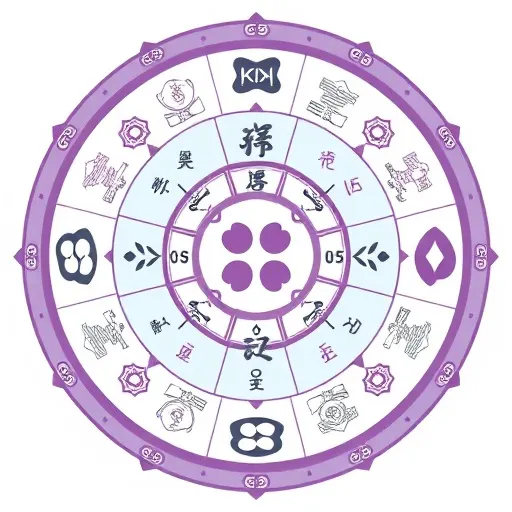
Bagua map as nine sq
What Is the Bagua Map and How Do the Eight Trigrams Work?
So, what exactly is the bagua map? The word itself translates roughly to "eight areas" or "eight trigrams," which pretty much tells you what you're dealing with. At its core, the bagua map is a grid — usually a nine-square grid — that you lay right on top of your home's floor plan, your office layout, or even just a single room. Each of the eight outer sections (plus that center square) lines up with a specific life theme: wealth, career, relationships, health, creativity, reputation, travel, and inner wisdom. Understanding how to use bagua map in feng shui starts with grasping this basic structure.
Think of it as a blueprint that links your physical environment to the different areas of your life. The concept is simple but pretty profound: by making intentional adjustments in a specific zone of your space, you can shift the energy — often called qi or chi — connected to that life theme. That's the heart of how to use bagua map in feng shui.
What confuses a lot of people is that there are actually two main ways to lay the bagua over a space:
- Classical (compass) method — This one uses an actual compass reading, often tied to a traditional compass tool, to align the bagua with true directions. It's the older, more traditional approach.
- Western (BTB) method — Also called Black Hat Sect or BTB, this approach aligns the bagua with the front door of the space rather than compass directions. It's way more accessible for beginners and super popular in modern practice.
Neither one is "wrong." They're just different lenses for how to use bagua map in feng shui. For most beginners in 2026, the western method is the easier on-ramp, but it's worth knowing both exist so you can pick the framework that resonates with you.
Why the Bagua Map Still Matters for Intentional Living and Spatial Design Today
You might be wondering whether an ancient mapping system has any relevance in a world of smart homes and hybrid work. The answer, according to a growing number of modern practitioners, is a resounding yes — and arguably more than ever. The bagua map is fundamentally a tool for intentional living. It asks you to look at your space and ask, "Does this area reflect what I actually want in my life?" In an era where so many people feel scattered, overwhelmed, or disconnected from their environments, that kind of deliberate attention is genuinely valuable. Professionals who work in spatial design and wellness have noted that even clients who don't consider themselves spiritual often find the bagua framework useful as an organizing principle for decluttering and purposeful layout. That's a big part of why how to use bagua map in feng shui keeps coming up in design conversations.
One seasoned practitioner in the wellness design space put it this way: "The bagua map doesn't magically change your life. What it does is make you conscious of your surroundings — and that consciousness changes how you live." That's a framing that resonates with a lot of people, regardless of their background.
Getting Started: Step-by-Step Guide on How to Use Bagua Map in Feng Shui for Beginners
Alright, let's get practical. Here's a step-by-step walkthrough of how to actually put the bagua map to work in your home. This is the nuts-and-bolts of how to use bagua map in feng shui.
Step 1: Choose Your Method — Compass Reading vs. Western BTB Approach
Before you do anything, decide whether you're going to use the compass method or the western (BTB) method. If you're a total beginner, start with the western method because it's simpler: you align the bottom of the bagua grid with your front door and work from there. If you're drawn to a more traditional approach or you already have a compass reading for your home, the classical method might suit you better. Either way, this decision shapes how to use bagua map in feng shui for your specific space.
Step 2: Draw Your Floor Plan with the Front Door Marked
Sketch out a simple floor plan of your home or the room you want to work with. It doesn't need to be architectural — a rough outline with the front door marked is plenty. This will be your canvas for the bagua overlay.
Step 3: Overlay the Nine-Square Grid and Life Areas
Place a nine-square grid (3x3) over your floor plan.
- Western method: Align the bottom edge of the grid with the wall that contains your front door. The bottom-center square is your career area; the bottom-left is knowledge and self-cultivation; the bottom-right is travel and helpful people.
- Compass method: Use a compass reading to align the grid with true north. The grid then maps to actual directions, and you match those to the corresponding life areas.
If your home isn't a perfect square — and let's be honest, almost none are — just extend the grid proportionally to cover the entire footprint. The bagua is a conceptual tool, not a literal blueprint.
Step 4: Identify the Nine Life Areas and Their Elements
This is where it gets fun. Here's a quick rundown of what each of the nine sectors represents (using the western layout, with the front door at the bottom):
- Career (bottom-center): Your professional path, life purpose, and how you flow through the world.
- Knowledge & Self-Cultivation (bottom-left): Learning, wisdom, and personal growth.
- Family & Community (middle-left): Your relationships with family, friends, and community.
- Wealth & Prosperity (top-left or far-left, depending on layout): Abundance, financial flow, and gratitude.
- Fame & Reputation (top-center): How you're seen, your contributions, and your integrity.
- Relationships & Love (top-right or far-right): Romantic partnerships and deep connections.
- Creativity & Children (middle-right): Creative expression, projects, and legacy.
- Travel & Helpful People (bottom-right): Support networks, mentorship, and new horizons.
- Health & Center (mid-center): Overall well-being, balance, and grounding.
Each of these sectors is associated with an element (wood, fire, earth, metal, water), a color, and often a shape. That's where the adjustments come in — and it's a key piece of how to use bagua map in feng shui effectively.
Step 5: Analyze, Declutter, and Adjust Each Sector
Once you've mapped the areas, walk through each sector and assess it. Ask yourself:
- Is this area cluttered, dark, or neglected?
- Does the décor reflect the energy I want in that life area?
- Are there any broken items, dead plants, or things that feel "stuck"?
Then make adjustments. This might mean decluttering, changing the color palette, adding plants, improving lighting, or repositioning furniture. The bagua map isn't about superstition — it's about aligning your environment with your intentions. A tidy, thoughtfully arranged space is easier to feel good in, and that feeling is the whole point. This assess-and-adjust loop is really what how to use bagua map in feng shui looks like in practice.
Common Mistakes: Treating Bagua as Rigid and Over-Cluttering with Fixes
Let's tackle the pitfalls that trip up most beginners.
Mistake #1: Treating the Bagua as Rigid. The bagua map is a tool, not a rulebook. If your bathroom lands in the wealth sector and you panic, take a breath. Practitioners will often tell you that the point isn't to avoid "bad" placements — it's to be intentional about how you use the space. Add a plant, keep it clean, and move on.
Mistake #2: Forgetting the Center. The center of the bagua grid — the health and balance sector — is easy to overlook because it doesn't map to an outer wall. But it's arguably the most important sector, since it anchors everything else. Keep the center of your home (or your living room) clear, grounded, and balanced. This is a step people often skip when learning how to use bagua map in feng shui.
Mistake #3: Over-Cluttering with "Fixes." More décor isn't always better. Some people go overboard adding water features, mirrors, and crystals to every sector. A seasoned practitioner in spatial wellness points out that the most effective bagua adjustments are usually the simplest ones: clearing clutter, improving light, and being intentional about what you bring in. Less is often more.
Mistake #4: Skipping the Compass Check. If you're using the classical method, you actually need a compass reading. Skipping this step and guessing means your grid will be misaligned, which undermines the whole exercise. It's worth taking five minutes to get it right.
Bagua Map in Small Spaces, Rentals, and Home Office Setups
Here's a question that comes up constantly: "Can I use the bagua map if I live in a tiny apartment or a rental?" Absolutely. The bagua works at any scale — a single room, a desk, even a single corner of a room. If you're renting and can't paint walls or knock down partitions, you can still make meaningful adjustments with plants, textiles, lighting, and decluttering. Some practitioners even recommend overlaying the bagua on your desk or workspace if you work from home, which is a nice way to bring intention to your professional life. Knowing how to use bagua map in feng shui in a rental is honestly one of the most practical skills you can pick up.
Sample Walkthrough: Applying Wealth Sector Adjustments in a Closet
Let's imagine you've drawn your floor plan and overlaid the grid using the western method. Your front door is at the bottom-center. You notice the wealth sector (often the far-left or top-left square) is your entryway closet — dark, cluttered, and full of things you never use. What do you do?
- Clear it out. Remove anything broken, unused, or unloved. Decluttering is the foundational move.
- Add light. A small lamp or some warm LED strips can transform a dark closet into a space that feels alive.
- Introduce the right element. The wealth sector is typically associated with wood and the color green. A small plant or a green accent can reinforce that energy.
- Keep it maintained. The bagua isn't a one-and-done exercise. Check in periodically to make sure the space still feels aligned.
That's the whole process — assess, adjust, maintain. Repeat as needed. And that, in a nutshell, is how to use bagua map in feng shui without overcomplicating it.